
Blog
MF DOOM Discography: Every Album Ranked and Explained
Sep
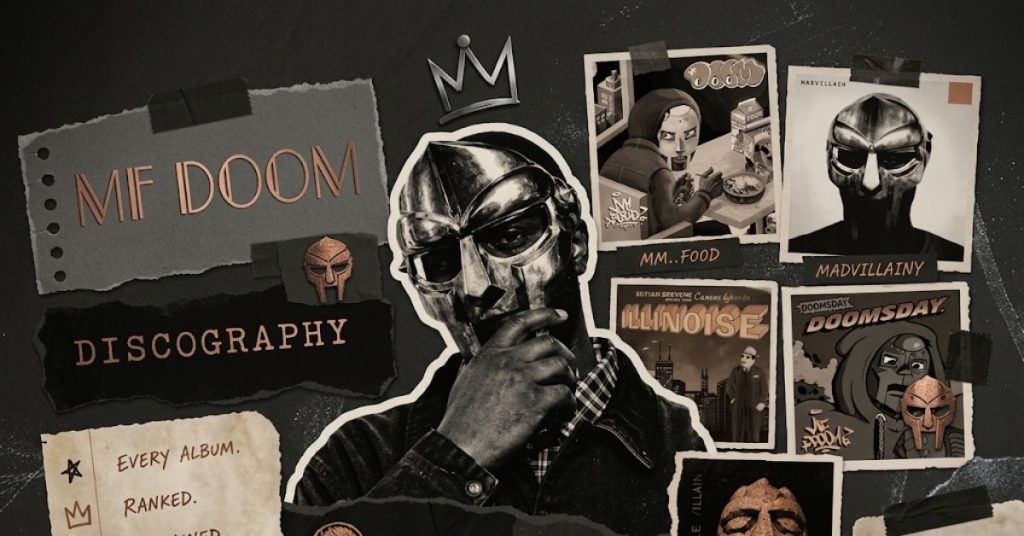
MF DOOM didn’t just make records. He built a masked universe, complete with aliases, alter egos, collaborative personas, and instrumental vaults that most fans spend years trying to fully map. The MF DOOM discography is one of underground hip-hop’s most layered catalogs, and the “right” starting point genuinely changes what you hear when you eventually go back to the beginning. A fan who finds Madvillainy first hears something completely different than a fan who starts with Operation: Doomsday, even when they eventually own the same records.
That layered quality is also why fans tend to align hard with specific album eras. Doomsday purists wear it differently than Madvillainy devotees, and both are different from the Viktor Vaughn faithful. At MF DOOM Merch Official, album-specific graphic tees and hoodies exist precisely because that allegiance is real, and it deserves to be worn accurately. This guide is structured to help you understand the full catalog before you decide which era you belong to.
The structure here moves from essential entry points to the alias universe, then into MF DOOM collaborations, collector intel, and deep cuts. Work through it in order and the references start stacking on themselves the way DOOM intended, each section building context that makes the next one land harder.
Top rated products
-
MF DOOM Graffiti T Shirt – Yellow Washed Vintage & Striped Logo | MF DOOM Merch
Original price was: $ 110.00.$ 74.99Current price is: $ 74.99. -
Blue MF DOOM Hoodie All Caps Quote Distressed Mask | MF DOOM Merch
Original price was: $ 120.00.$ 98.99Current price is: $ 98.99. -
King Geedorah x MF DOOM T Shirt Black – Rapper Metal Face Graphic Streetwear Tee
Original price was: $ 110.00.$ 73.99Current price is: $ 73.99. -
Black MF DOOM Sweatshirt Printed Metal Face Graphics Unisex – Premium Cotton | MF DOOM Merch
Original price was: $ 130.00.$ 98.99Current price is: $ 98.99. -
MF DOOM Hoodie Royal Blue Graffiti Logo & Mask – Premium Quality | MF DOOM Merch
Original price was: $ 120.00.$ 98.99Current price is: $ 98.99.


Essential entry points in the MF DOOM discography
The MF DOOM discography rewards a deliberate listening order. New fans who jump straight into a random alias project often miss the context that makes the references land. The following three albums are the foundation. Everything else in the catalog builds on them, riffs on them, or reacts against them.
Operation: Doomsday (1999): the origin of the villain persona
This is where the metal mask mythology begins. Released in 1999 on Fondle ‘Em Records, Doomsday was DOOM’s comeback after the KMD years and the death of his brother Subroc, and the grief and defiance in it are unmistakable. “Doomsday” and “Rhymes Like Dimes” define his early cadence: loose on the beat but surgical with the syllables, always operating slightly outside where you expect him to land.
Pressing history matters here more than with almost any other record in the catalog. The original 1999 Fondle ‘Em pressing commands $1,500 to $3,000 in near-mint condition on Discogs, partly because the run was tiny and partly because collector demand surged after DOOM’s death on October 31, 2020, a loss his family publicly announced on December 31, 2020. The 2001 Sub Verse reissue has a slightly altered tracklist, so it’s technically a different artifact. The 25th Anniversary Sketch Edition vinyl from 2024, pressed on translucent green and reported to be limited to 4,000 units with artwork by Keo, is the most accessible physical version for fans buying in now.
Madvillainy (2004): the record critics and fans agree on
Most guides tell new listeners to start here, and the reputation is earned. Madvillainy is DOOM’s collaborative peak with producer Madlib, and the album’s fragmented, loop-driven structure rewards attentive listening in a way that few records in any genre do. “Accordion” is the track that converts casual listeners into obsessives, critics and fan communities have consistently singled it out as the album’s defining moment. “All Caps” is the one they quote for the rest of their lives.
What makes Madvillainy the consensus entry point isn’t just the quality. It’s the completeness of the vision. Every track is short, dense, and moves without warning. There’s no filler, no interludes that overstay their welcome. For a first-time listener, that pacing teaches you how to listen to DOOM before you even realize it’s doing that.
MM..FOOD (2004): concept-driven wordplay at its most dense
Released the same year as Madvillainy, MM..FOOD is the album that rewards re-listens most aggressively. The food metaphor threading through the entire project isn’t a gimmick; it’s a structural commitment that makes the whole record feel unified. “One Beer” and “Rapp Snitch Knishes” are the fan-consensus signature tracks, but “Curls” is the one that catches long-time listeners off guard every time.
The 2024 20th Anniversary deluxe edition, promoted as the most feature-rich reissue of the album to date, includes refreshed cover art, a bonus “Kookies” 7-inch, rare remixes from Madlib, Jake One, and Ant, and unreleased interview clips. If you’re buying one physical version of MM..FOOD in 2026, the deluxe is the one to own.
The MF DOOM discography: alias universe (Viktor Vaughn, King Geedorah, Danger Doom)
DOOM’s aliases aren’t marketing gimmicks or label obligations. Each one carries a distinct character, production aesthetic, and lyrical angle. These three alias projects are essential after the core three, not optional deep cuts for completists. Taken together, they form the backbone of the Viktor Vaughn discography and King Geedorah albums that fill out the broader DOOM catalog.
Vaudeville Villain (2003): Viktor Vaughn’s raw bar showcase
Viktor Vaughn drops the villain theater in favor of something harder and more confrontational. The production, handled largely by Heat Rocc, has a grittier texture than Madvillainy. “Lickupon” and the title track are where the album’s identity is clearest. This is the record for listeners who want lyricism front and center without the conceptual abstraction, and fan rankings frequently place it just below MM..FOOD among DOOM’s strongest full statements.
Take Me to Your Leader (2003): King Geedorah’s sci-fi worldbuilding
King Geedorah is DOOM operating in full character mode, rapping mostly in the third person and building a cosmic, B-movie villain narrative across the album’s runtime. “Anti Matter” and “Next Levels” are the essential tracks. Both Vaudeville Villain and Take Me to Your Leader dropped in 2003, making that year arguably the most underrated in the entire DOOM catalog. Together, the King Geedorah albums and the Viktor Vaughn discography expand the character universe that Doomsday introduced and Madvillainy later refined.
The Mouse and the Mask (2005): the most accessible collaboration in the catalog
Danger Doom with Danger Mouse is the entry point for fans who find DOOM’s denser solo records overwhelming. The Adult Swim tie-in made it one of the most culturally visible releases in his catalog, and tracks like “A.T.H.F.” and “The Mask” land even without deep DOOM knowledge. Rank it as the best gateway for casual hip-hop fans, but understand that it sits below the alias projects in overall depth. A 2017 Metalface Edition reissue is the most complete version of the project.
MF DOOM collaborations and side projects that complete the picture
After the solo alias work, the MF DOOM discography branches into a network of duo projects and one-off collaborations. These fill critical gaps in the full releases list and document how DOOM’s output evolved across the 2000s and into the 2010s.
Madvillain: the full project beyond Madvillainy
Madvillain as a project extends well beyond the 2004 album. The Madvillainy Instrumentals (2004), the Four Tet and Koushik remixes (2005), and Madvillainy 2: The Madlib Remix (2008) are all part of the Madvillain discography, and collectors treat them as companion pieces rather than bonus material. The 2008 Stones Throw box set is the completist’s version of the whole project. If you’re building a serious collection, the box set is the target.
JJ DOOM and NehruvianDoom: the later era collaborations
Key to the Kuffs (2012) with Jneiro Jarel and NehruvianDoom (2014) with Bishop Nehru represent DOOM’s late-period collaborative work, and both received Redux editions (2022 and 2019 respectively) that are the best current versions to seek out. NehruvianDoom in particular is an underappreciated record: Bishop Nehru’s rapid-fire delivery creates a productive tension with DOOM’s slower, more deliberate flow that neither artist would replicate elsewhere. These reward listeners who’ve exhausted the core catalog and are ready to hear DOOM working against a genuinely different kind of energy.
Czarface and the final chapter
Czarface Meets Metal Face (2018) was released two years before DOOM’s death on October 31, 2020. Super What? (2021) arrived posthumously, which gives it a different weight than anything else in the catalog. Both records are essential for completing any serious survey of DOOM’s full output. For listeners approaching the catalog chronologically, the KMD albums, Mr. Hood (1991) and Black Bastards (1994), function as a pre-DOOM origin story worth revisiting once you already know the solo work.
Reissues, anniversary pressings, and where to find rare copies
The MF DOOM vinyl market is active and consequential. Knowing which pressing you’re buying matters for both audio quality and long-term collectibility, and the gap between a first pressing and a reissue can represent thousands of dollars in resale value.
Anniversary editions worth owning in 2026
The two most significant recent reissues are Operation: Doomsday’s 25th Anniversary Sketch Edition (2024) and MM..FOOD’s 20th Anniversary deluxe vinyl (2024). The Doomsday pressing is notable for the Keo-designed linework cover and the translucent green vinyl format, reported as limited to 4,000 copies. The MM..FOOD deluxe includes the refreshed cover art, the bonus “Kookies” 7-inch, and remix material from Madlib, Jake One, and Ant. For vinyl collectors building a DOOM shelf in 2026, these two are the clearest priorities among currently available physical editions.
For higher-end collecting, first pressings of Madvillainy on Stones Throw typically trade between $200 and $400 depending on condition, a range reflected in completed Discogs sales, and complete sets of the Special Herbs instrumental series can collectively exceed $1,000. The original 1999 Fondle ‘Em Doomsday is the crown jewel of any serious DOOM collection, but near-mint copies rarely surface below $1,500 based on current marketplace data.
Where to stream and where to buy physical copies
Streaming options are solid across the board. Spotify, Apple Music, Amazon Music, Tidal, and Qobuz all carry substantial portions of the MF DOOM discography, Apple Music has confirmed the 20th Anniversary Edition of MM..FOOD in its catalog. For physical copies, Discogs remains the most authoritative resale marketplace for identifying exact pressings and verifying condition grades, with completed sales histories that let you track real market prices over time. eBay is the secondary option for out-of-print editions. The official Bandcamp pages for Stones Throw and Lex Records surface label-linked releases including JJ DOOM material, and the Lex Records page is worth bookmarking for catalog completists.
Deep cuts for veterans and how to rep your favorite DOOM era
Once you’ve mapped the core catalog, the real listening starts. DOOM’s output rewards obsession, and the deep cuts reveal how consistent his quality was across projects that most casual fans never reach.
Under-the-radar tracks across the full catalog
The Special Herbs instrumental series, released as Metal Fingers across nine volumes between 2001 and 2005 and later compiled into the 2006 box set, contains some of DOOM’s most inventive beat work anywhere in the catalog. Fans who value his production as much as his rapping treat these as essential listening. Born Like This (2009, released simply as DOOM) is routinely underrated despite being his last major solo statement; “Cellz” in particular ranks among his most visceral tracks and belongs on any serious DOOM playlist.
Within the main albums, the deep-cut consensus points to “Kon Queso” and “Kon Karne” as criminally overlooked. “Raid” and “Shadows of Tomorrow” from Madvillainy are the tracks that separate fans who’ve listened once from fans who’ve listened thirty times. “Nautical Depth” and “Bomb Thrown” are the kind of cuts that reward catalog completists who’ve already worn out the obvious singles.
Album-specific merch for fans who know their era
Hardcore fans tend to align with a specific era of the catalog, and that alignment is genuine enough to be worth wearing. Whether you’re a Doomsday purist, a Madvillainy devotee, or a fan who came in through Viktor Vaughn, MF DOOM Merch Official carries album-specific graphic tees and hoodies built for exactly that kind of allegiance. The collections are designed for fans who treat the MF DOOM discography as a cultural identity, not background music. Shop the full range to find the piece that places you in the right era.
The catalog rewards patience because DOOM built it that way
The MF DOOM discography is best approached with intention: start with the essential three, expand into the alias universe, then let the MF DOOM collaborations and deep cuts reveal themselves over time. Rushing through it misses the point. DOOM layered references, characters, and production choices across a catalog that spans more than two decades, and the connections between records only become visible after multiple passes through each one.
As a complete creative statement, DOOM’s discography holds a singular place in underground hip-hop. Few artists have built a comparable universe of aliases, each with its own coherent identity, while sustaining this level of lyrical and sonic quality across all of them. Critics and catalog scholars have repeatedly framed the alias work as one of hip-hop’s most ambitious long-form projects. Whether you’re just starting with “Accordion” or hunting a first-press Vaudeville Villain on Discogs, the entry point matters less than the commitment to go deeper. The catalog will meet you wherever you are.
